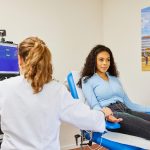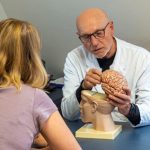
Patients with dizziness or similar complaints (balance disorder, gait unsteadiness, coordination disorder) often have additional tests after the physical neurological examination. These are intended to help document disturbances in the vestibular system. The vestibular system is naturally closely related to the auditory and visual systems. These systems are therefore also specifically examined in order to reah conclusions about disturbances in the vestibular system.
To avoid false results from the test, it is recommended that dizziness, sedative and sleep medication as well as alcohol not be taken for a few days beforehand. If this is not possible, it is still necessary to provide precise information on the medications taken.
Videooculography (VOG)
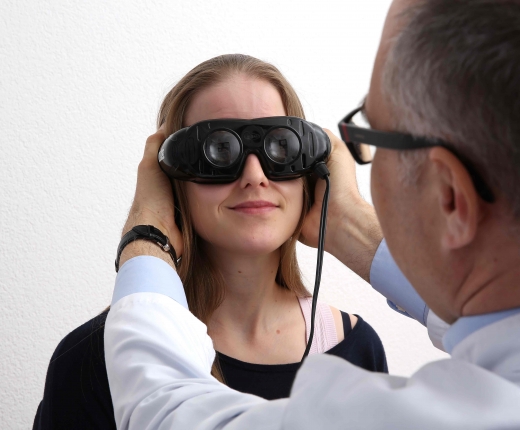
This examination uses special glasses to record changes in eye movements using miniature cameras while the vestibular system is stimulated. The stimulation can take place either via head rotation (head impulse test) performed rapidly on you by the examiner or via blowing cooled or warmed air into the ear (=caloric test, calorimetry).
Determination of the Subjective Visual Vertical (SVV)
Using special glasses, the outside world is optically shielded and the patient is shown a line which must be brought into a vertical position (=perpendicular, at right angles) using a small lever in their hand, based on their subjective impressions. In some cases of vertigo, this task cannot be performed accurately enough.
Vestibular evoked myogenic potentials (VEMP)
This is a measurement of reflex muscle responses following stimulation of the vestibular system. The stimulus response in the muscle is triggered by stimulation of the vestibular system (vestibular evoked). Muscle activity is measured with electrodes attached to the skin below the eye or to the neck over the muscle (myogenic potentials). Stimulation is either by vibration on the forehead or by loud clicking sounds through headphones.
All these examinations are harmless but can cause dizziness in some individuals. However, this usually goes away within a short time.