Symptoms
The symptoms caused by narrowing (synonym: stenosis) of the spinal canal (synonym: spinal canal) can vary depending on the nerves affected. If the spinal canal is narrowed above the lumbar spine, the spinal cord is usually affected and the typical symptoms of partial paraplegia may occur.
However, it is usually the lumbar spine that is affected, as this is where the greatest overall load occurs during life. The vertebral canal in the lumbar spine mainly contains the nerve roots for the legs. Typical symptoms are pulling pains at the front and back of the legs which, in contrast to a herniated disc, are rarely attributable to a specific nerve root and thus to a specific muscle group or skin area. During prolonged walking, the narrowed spinal canal causes the nerve roots running through it to be squeezed, so that their blood supply is disturbed. The patient then often has to stop walking for a short time (“shop window disease”). The resulting pain usually subsides when they sit down for a moment or bend forward, since this makes the spinal canal slightly wider and the blood supply is restored. Over the years, the narrowing of the spinal canal usually increases steadily with the result that the pain-free walking distance steadily decreases.
Symptoms




Causes
Over a lifetime, the lower lumbar spine in particular is subjected to high mechanical loads and degenerative changes occur. The symptoms of the narrow spinal canal are usually due to the interaction of several factors: the intervertebral discs lose height and often bulge into the spinal canal, ligamentous structures thicken, bony protrusions form on the vertebral bodies, and the joints between vertebral bodies change and enlarge. The resulting narrowing (stenosis) of the spinal canal leads to entrapment of the nerve structures within it.
What we can offer
Treatment/progression
In mild cases, the treatment for spinal canal stenosis initially involves strengthening of the back and abdominal muscles, assisted by a physiotherapist, with the aim of stabilizing the forces on the bony spine and thus relieving the pressure. At the same time, inflammatory changes can be treated with medication. If the complaints nevertheless increase, there is the possibility of surgical decompression of the spinal canal. Here the canal is opened during a microsurgical operation and constricting elements such as bone extensions, thickened ligament structures, fat deposits or bulging intervertebral discs are removed. In particular, nerve roots constricted laterally in the spinal canal are specifically relieved. In most cases, it is possible to widen the spinal canal through minimally invasive surgery by creating a bony window on one side. In this procedure, the vault of the spinal canal is completely freed from space-occupying structures at the level of the window by microsurgery, and at the same time the stability of the spinal column is maintained. This operation can thus be performed at multiple levels (see computer simulation in the image on the left).
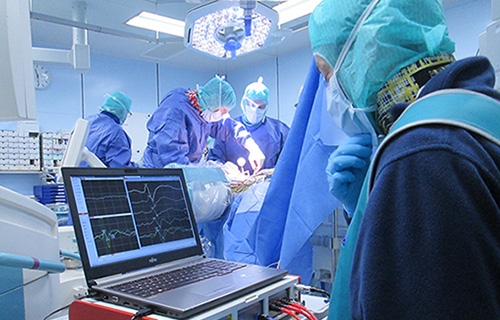
Particularly in the presence of spondylolisthesis, which can also narrow the spinal canal, it is also sometimes necessary to block the affected vertebral bodies. This is achieved by inserting screws into the vertebral bodies, which are then connected and fixed with rods. In addition, a titanium cage is often inserted into the intervertebral space. Sometimes a so-called intraoperative X-ray is performed for monitoring during the operation. Nerve function can also be continuously monitored by neurologists through intraoperative neuromonitoring.